


Hello Dear Reader,
Here’s a fact: did you know that honey never spoils? Thousands of years later, archaeologists have found jars of it in ancient Egyptian tombs that are still edible. When I first read that, it made me think about the timelessness of truth — how God’s Word endures in every generation, no matter how much the world changes.
This past month, the US has been in a state of turmoil over the assassination of Charlie Kirk. Whether you agreed with him or think that there is a more sinister plot at hand, there is one thing that cannot be denied: we are living in a time of Christian revival in America. I felt it and you can see it — young people gathering, communities praying, churches filling again. But revival isn’t just something happening “out there.” It’s also something God wants to ignite within each of us.
So I’ve been asking myself: Where is my relationship with Jesus today? Am I walking closely with Him, or am I letting the noise of life pull me away? Maybe you’re asking yourself the same questions.
One of my favorite quotes from Corrie Ten Boom is, “If Satan can’t make you sin, he’ll make you busy.”
Let’s not miss this moment. Let’s do our part — in prayer, in repentance, in boldness — and step fully into what God is already doing in our nation and pray that it is something that will last.
In today’s issue, we’re also going to take a little detour into the world of books — from graphic novels and to poetry, children’s stories, and more. I’ve found that God often uses stories to speak to us in ways we don’t expect. Sometimes it’s a parable from Scripture, other times it’s a line of poetry or even a scene in a novel that reminds us of His truth. As we look at these different kinds of books, I want to reflect on how they can open our eyes, stir our faith, and invite us to grow closer to Him.
KNEE SLAPPER THURSDAY

VERSE OF THE MONTH
“Who among you is wise and understanding? Let him show by his good behavior his deeds in the gentleness of wisdom.”
James 3:13 NASB1995
SERVINA
Our girl has been loving these treats this month. She’s just like me and when it comes to the quality of her food, she always opts for healthy and real! It’s available for purchase on Amazon.

THE VARIETY OF READING
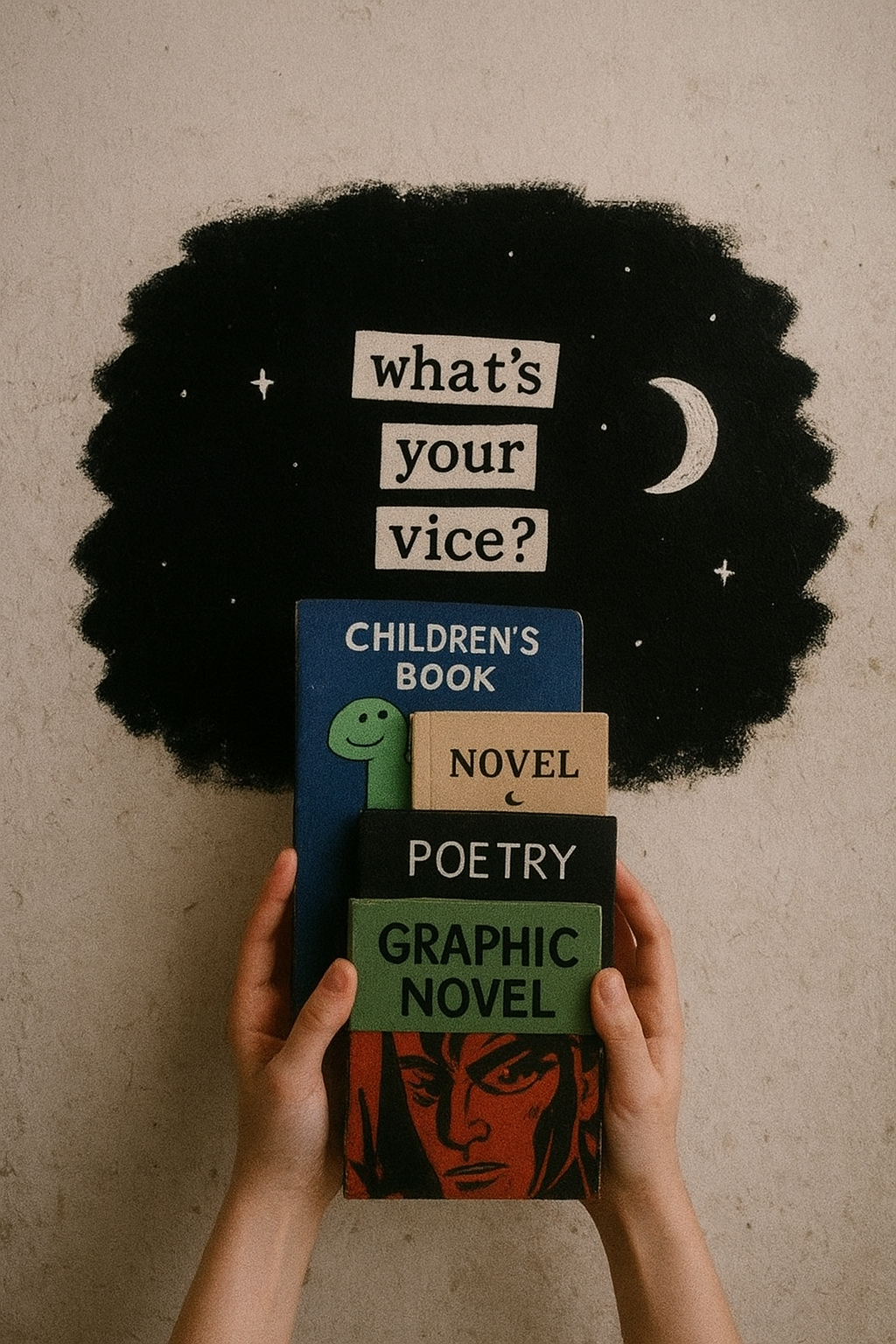
There are lots of different reading styles and everyone has their own category that they fit into. Honestly, sometimes people are so comfortable in their chosen category that they hardly venture to try something new.
Today’s your lucky day — I’m going to give you an inside look into a few of the different categories and then give you a challenge for this coming month. Are you ready?
NOVEL
The most commonly known and sought after literature style.
Definition: A long work of prose fiction that develops themes and characters over an extended narrative.
Length: Typically, 40,000+ words or more.
Style: Focuses on worldbuilding, plot, and deep character arcs.
Christian Example: A Voice in the Wind by Francine Rivers or The Abditory by Sara Gherasim.
Popular Example: Pride and Prejudice by Jane Austen or The Great Gatsby by F. Scott Fitzgerald.
SUB-CATEGORY: NOVELLAS
Definition: Longer than a short story but shorter than a novel. Focuses on a single conflict or idea.
Length: About 17,000–40,000 words.
Christian Example: The Shepherd by Frederick Forsyth.
Popular Example: The Strange Case of Dr. Jekyll and Mr. Hyde by Robert Louis Stevenson, or Of Mice and Men by John Steinbeck.
SHORT STORY
Definition: A brief work of prose fiction, often focused on one theme, one character, or one moment.
Length: Usually under 10,000 words.
Christian Example: A Good Man Is Hard to Find by Flannery O’Connor.
Popular Example: The Tell-Tale Heart by Edgar Allan Poe.
GRAPPHIC NOVEL
Definition: A story told primarily through illustrations and sequential art, with text in speech bubbles or captions. More complex and longer than comic books, often bound like a novel.
Length: Can range from short to very long,
Style: Defining feature is visual storytelling.
Christian Example: The Action Bible by Doug Mauss and Sergio Cariello.
Popular Example: Maus by Art Spiegelman or Attack on Titan by Hajime Isayama.
POETRY
Definition: Literature that expresses ideas and emotions through imagery, rhythm, and sound. Can be structured (hymns, sonnets) or free verse.
Length: Can vary; from short haikus to book-length epics.
Christian Example: The Book of Psalms in the Bible.
Popular Example: Leaves of Grass by Walt Whitman or The Waste Land by T.S. Eliot.
CHILDREN’S BOOK
Definition: Books written and illustrated specifically for children, often with pictures, simple language, and moral lessons.
Length: Can range from picture books to early chapter books.
Christian Example: The Jesus Storybook Bible by Sally Lloyd-Jones or Servina, The Friendly Dog by Sara Gherasim.
Popular Example: Where the Wild Things Are by Maurice Sendak or The Very Hungry Caterpillar by Eric Carle.
NOW FOR YOUR CHALLENGE:
Find a category from this list that you’ve either never read or one that you’ve hardly read. Pick a book from that category (either from my examples or from the internet) and read it this coming October.
Then, if you’re feeling really spicy, reach out to me and let me know what you think!
BOOK REVIEW
“GONE WITH THE WIND”
This month’s book is “Kindred” by Octavia Butler.
My Overall Opinion:
I remember the first time that I read this book back in the ninth grade. I hadn’t ever read anything quite like it, so boy was I intrigued. So much, in fact, that I think this set me on a trajectory into the world of time travel (clearly, if you’ve read my book). Now, rereading it with a perspective with gained life experience and now being Dana’s age, a plethora of things stood out differently to me. There are themes in this book that are definitely not things that should be taken lightly: abuse, suicide, profanity, and such. But seeing how Dana counteracts or endures the situations she is put into are quite interesting. You see her strength grow with each time she is thrown back to the antebellum South. I also enjoyed the symbolism in the book, for example, Dana traveling from the year 1976, the bicentennial celebration of the United States. It can be a harrowing and emotional read, but interesting, nonetheless.
My Favorite Character:
Hot take — when I first read this book, my number one was Rufus. I know, I know. He’s a demon monster who does horrible things. Now reading it for a second time, I thought my opinion might change, but I suppose not. The reason why he’s my favorite is because we slowly see his path towards demise. Starting off with the sweet innocent boy and then turning into the cruel man, I liked the way that Butler showed his evolution and how circumstance and surroundings potentially made him into what he was. This, of course, is up for debate. But I can’t help but feel that he’s only the monster of his surroundings and not one in his heart. Even Dana says, “He wasn’t a monster at all. Just an ordinary man who sometimes did the monstrous things his society said were legal and proper.”
Things I Didn’t Like / Would Change:
While I did enjoy the book and writing overall, I did feel like at times the writing was either a little stale or phrased in a way that was too “fanciful,” particularly in Dana and Kevin’s exchanges.
Ranking:
4/5 — While I did still enjoy the book, looking back, I’m surprised they had this on the ninth-grade curriculum. If meant for a slightly older audience, this is an interesting read.
Other Comments:
In 2022, Hulu came out with a TV series. I watched a couple episodes but couldn’t really get into it. Like most adaptations, it was fairly different from the book. For one, *spoiler alert* Kevin travels back in time sooner and stays near Dana for most of what I watched. While minor, I’m not usually a fan of book-to-movie adaptations if they don’t keep the heart of the story.
COMING NEXT MONTH
We’re going around the world!
See You Next Month!
